


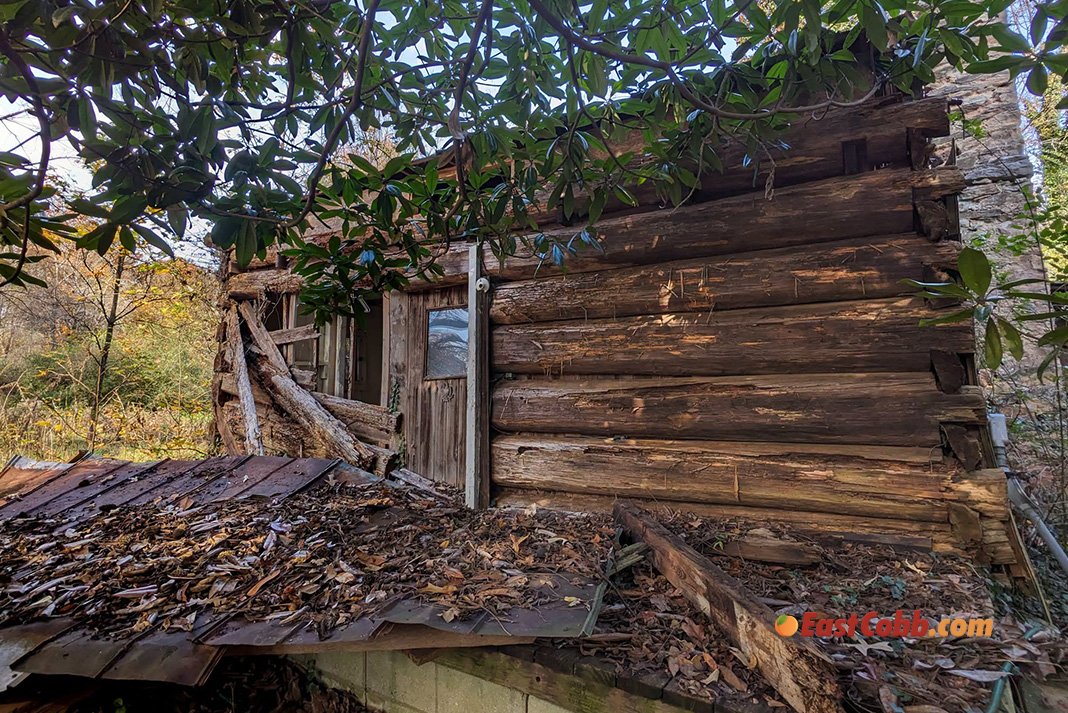
For nearly two hundred years, a small log cabin remained beside what became Post Oak Tritt Road in East Cobb. Roads widened, farms became subdivisions, and traffic replaced wagon wheels, but the cabin stayed at 4701 Post Oak Tritt Road until 2024.
Cars drove by for decades, unable to see the history just beyond the trees. Over time, logs rotted, sections collapsed, and development pressure put the building in real danger. Preservation crews eventually decided it was worth saving and took it apart piece by piece, labeling the surviving materials and moving them toward a new life at Hyde Farm Park.
A Cabin With an Uncertain Birth Date
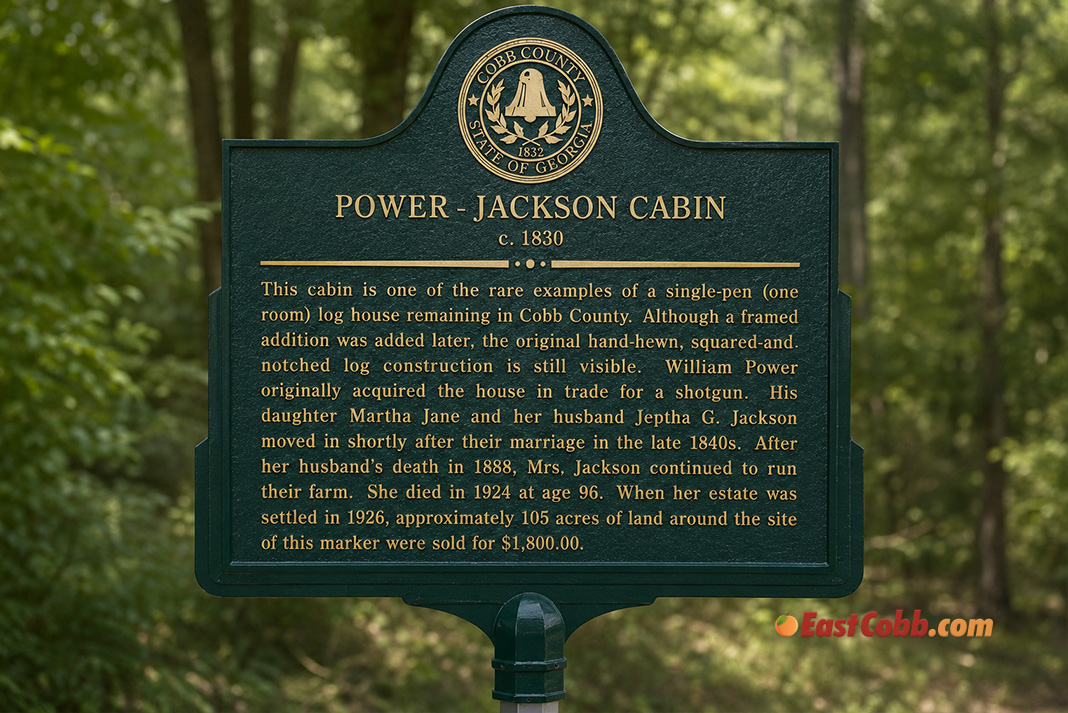
The roadside historical marker above dated the Power-Jackson Cabin to about 1830. That date has never been confirmed, and modern research leaves open the possibility that the oldest section predates Cobb County itself, which was created in 1832.
Cobb Landmarks has worked with the University of West Georgia to study tree rings from the cabin’s timbers. The research could identify when trees used in the building were cut, but no final construction date has been published in the sources reviewed by July 2026. For now, the cabin is best described as dating to the early or middle 19th century, with evidence that it could be Cobb County’s oldest surviving building.
A Shotgun, a Marriage and a Farm
The historical marker above also says William Power acquired the house in trade for a shotgun and identifies Martha Jane Power as his daughter. Later research from Cobb Landmarks and the National Park Service identifies Martha Jane as a daughter of Joseph and Isabella Power. The shotgun account remains part of the cabin’s recorded history, but the precise chain of ownership before the Jackson family is less settled than the old marker suggests.
Martha Jane Power married Jeptha C. Jackson around 1848, and the couple lived near Sandy Plains and Shallowford roads. They farmed the surrounding land for decades. Jeptha Jackson died in 1888, but Martha Jane continued managing the farm. She died in 1924 at age 96. When her estate was settled in 1926, about 105 acres surrounding the cabin were sold for $1,800.
Those dates show that the cabin was an important part of one family’s daily life across most of the 19th century and into the automobile age. Martha Jane’s long management of the farm also adds a chapter that old property histories often reduce to a sentence, even though keeping a farm operating after 1888 was not exactly a ceremonial role.
Building the Cabin
The Power-Jackson Cabin began as a single pen house, meaning its original living space consisted of one room. Framed rooms and a small kitchen were added later, along with two chimneys and hearths.
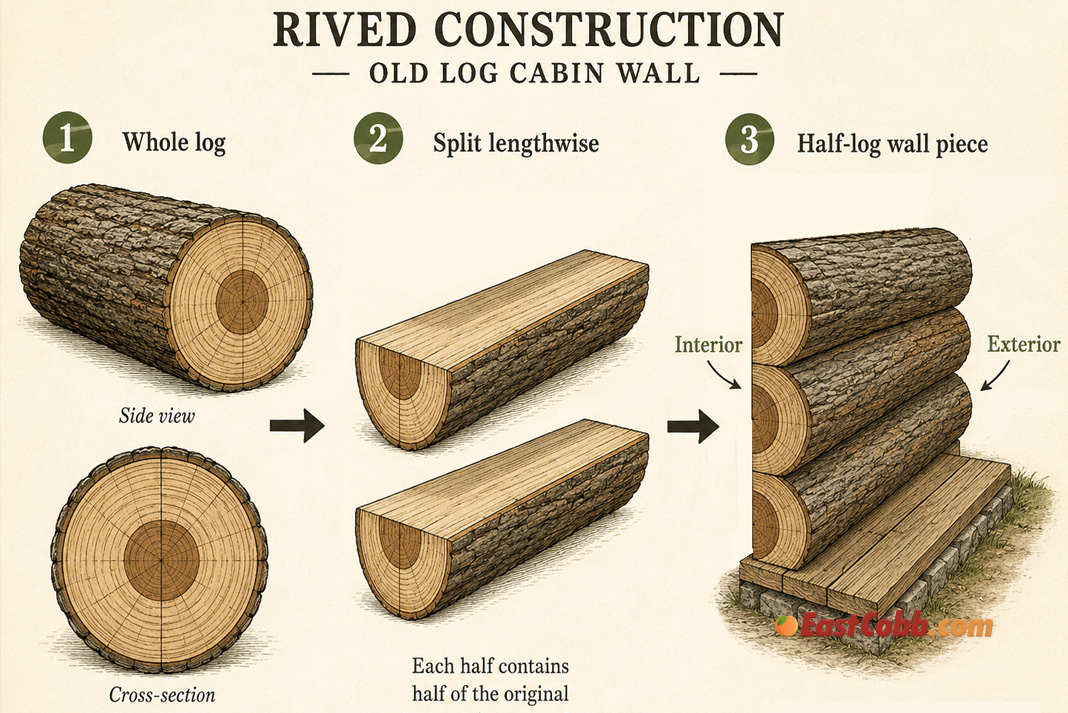
The above marker described the cabin as having hand hewn, squared and notched logs. Later examination by Cobb Landmarks identified the original pen as a rare rived log structure. In rived construction, a large log is split lengthwise. The curved outer surface faces outside, while the flatter split face forms the interior wall. A single tree could produce two wall logs, an economical technique that also left a distinct architectural fingerprint.
Very few single pen log houses remain in Cobb County, and the rived construction makes this example even less common. It records how early occupants used nearby timber, basic tools and practical geometry to build shelter before lumberyards, building codes and two car garages entered the picture.
Neglect, Development, and a Race Against Decay
The cabin spent years on private property with limited maintenance. By the early 2020s, weather and rot had damaged major sections, including logs near the front.
A proposed subdivision on the roughly 13 acre Post Oak Tritt property brought fresh attention in 2023. Cobb Landmarks pressed for the cabin’s protection during zoning discussions. Reports of possible 19th century graves on the property also complicated future development. Their precise location has not been confirmed, and crews avoided the suspected burial area during the cabin’s removal.
The rezoning request was withdrawn. The property owner later allowed Cobb Landmarks to acquire and remove the cabin, opening a narrow path between demolition by bulldozer and collapse from decay and gravity.
Saving a House by Taking It Apart
Cobb Landmarks and Cobb County PARKS reached an agreement in 2023 to relocate the cabin to Hyde Farm Park. Donors provided $70,000 for the disassembly, tagging and relocation.
In August 2024, a four person crew from Leatherwood Inc. spent six days documenting the structure. Each usable log was tagged and numbered so it could return to its original position. Chimney and hearth stones were removed, and materials from the later kitchen addition were retained for reconstruction.
The cabin had occupied the Post Oak Tritt site for close to 200 years. It left on trucks, in numbered pieces.
Cobb County commissioners approved SPLOST money for reconstruction at Hyde Farm in April 2024. In December, commissioners approved $354,000 for restoration work, including a stone foundation, new flooring, weather protection and treatment against insects.
A New Home at Hyde Farm
Hyde Farm links the cabin back to other branches of the Power family.
James Cooper Power settled the Hyde Farm property during the 1830s. His original cabin survives inside the larger Hyde farmhouse built around it during the 1920s. On adjacent land is the George Abner Power cabin, commonly called the Power Family Cabin, built about 1843 and occupied by Morning Washburn since 1971 under an agreement with Cobb Landmarks.
Once reconstruction is finished, the Hyde Farm area will add a third early log home associated with members of the Power family, and each have a unique history and ownership path. That grouping will let visitors compare construction methods and household changes across related properties.
The Restoration Has Taken a Tennessee Detour
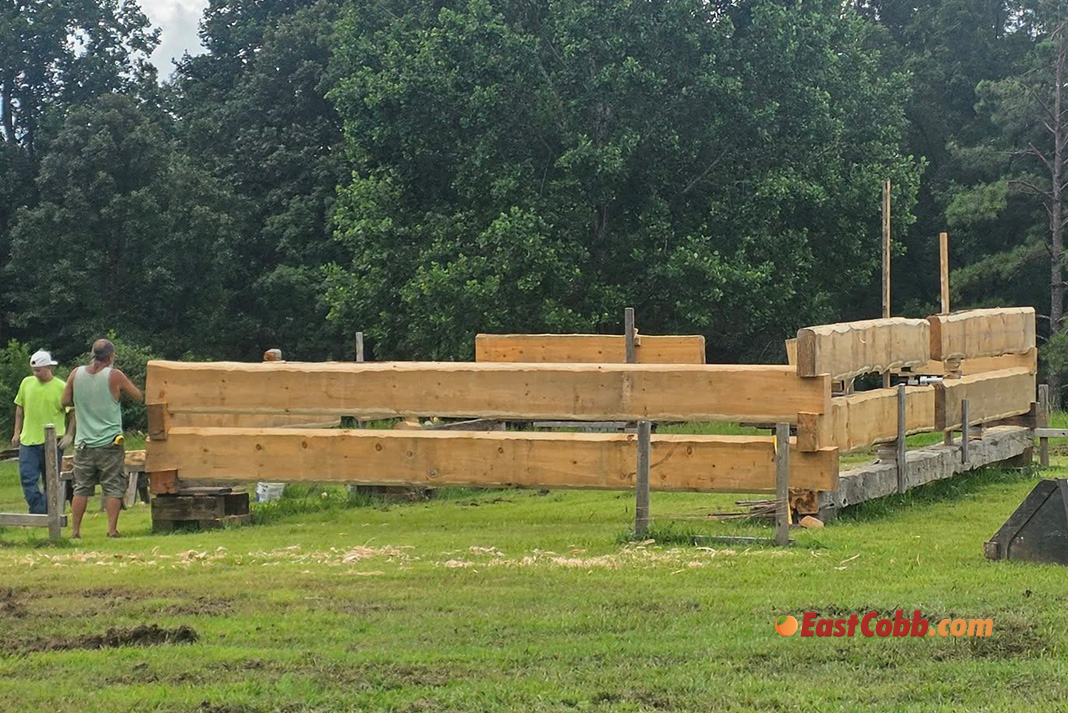
After the 2024 move, the cabin’s components were sent to Leatherwood in Tennessee for assessment and fitting. Specialists inspected each log and board to decide what could be reused and what had deteriorated beyond repair.
Cobb Landmarks reported in July 2026 that some original logs could not be saved after years of exposure. Craftspeople produced replacement logs with axes and hand tools based on early techniques. The cabin was undergoing an initial assembly in Tennessee so every component could be fitted, tagged and numbered before transport back to Cobb County.
Once that trial assembly is complete, the cabin will return to Hyde Farm Park for final reconstruction. The plan calls for public access after restoration, giving the building a future that looked unlikely only a few years earlier.
What the Power-Jackson Cabin Represents
The cabin’s importance does not depend on a famous battle, a president sleeping there or a ghost with suspiciously modern social media skills. Its value comes from survival.
It documents early domestic construction, the spread of the Power family across East Cobb, Martha Jane Jackson’s decades managing the farm, later changes made by successive occupants and the difficult choices involved in protecting an old building on developable land.
It also presents preservation honestly. Saving the cabin did not mean freezing every rotten board in place. Some material had already failed. The current project uses original components where possible, replacement timber where necessary and extensive documentation so the rebuilt structure retains a clear connection to the house that remained on Post Oak Tritt Road for generations.
The Power-Jackson Cabin survived farm life, family changes, suburban growth and long neglect. Its next chapter begins after a trip to Tennessee, a pile of numbered logs and a bill far larger than the shotgun once exchanged for it.